King Aardvark's Kick in the Nuts
Turgid ideas about science, engineering, religion, and politics. Turgid because I'm too lazy to do research or write a complete essay. If you have a problem with that, well, I don't care.
16 January 2010
12 February 2009
Happy Darwin Day!
I guess in commemoration of the event, the National Geographic TV channel was having a bunch of evolution-themed programming over the weekend. Specifically, they had three episodes of the show "Evolution" featuring whales, birds, and bears, respectively. They were pretty interesting, though I had many peeves.
First off, they used language with heavily Lamarkian connotations. An animal "decides to push its boundaries" or a feathered dinosaur "attempts to leap to a branch that's just out of reach." That's not what it is at all, rather, certain microraptors found they could leap and glide farther than their colleagues, thus outbreeding them and passing on the genes that allow for improved flight characteristics to their offspring.
Secondly, they did a really poor job in portraying evolution as occurring within a single individual instead of the gene pools of populations.
Third, too much filler graphics and not enough content.
National Geographic followed this up with a program called Darwin's Lost Voyage, which was an interesting program covering the Beagle voyage. Good show, but the title makes no sense. In what way has Darwin's voyage been "lost?" I already have three books on the subject. There is tonnes of info on the internet. Hell, Darwin gained fame as a popular writer for publishing an account of the Beagle's adventures upon his return to England. The only place where the voyage is being lost is deep in creotard territory where they are actively suppressing Darwin.
Anyway, happy Darwin Day. May you not come down with any horrible, vomit-inducing mystery diseases like Darwin did.
Labels: biology, Darwin Day
27 February 2008
Monkeys fling poo, just like us!
There’s this bargain bookstore that I go to frequently in Toronto where I’ve found such wonderful things as Carl Zimmer’s Parasite Rex and Evolution: The Triumph of an Idea, which you just can’t find anywhere else these days (on sale, that is). The past couple of times I’ve been in this bookstore, I’ve covetously passed by a largish coffee table book on apes, very tempted to buy it, but each time passing it up because of the $25 price tag and the fact that it is light on fact, heavy on photos. I like info, so that's a bit of a problem. That said, many of the photos are hilarious and just prove that you don’t need to put a chimp in a tuxedo to make it funny.
However, I’m thinking that I should be picking it up, and not just to laugh at the ape antics. Part of the reason religious fundies don’t like evolution is the “I don’t come from no monkey” mindset (complete with bad grammar). They, and sadly this “they” includes my wife, think it’s a horrible, demeaning idea that we’re related to grimy, stupid, poo-flinging animals. Perhaps if they just stretched their brains more they’d see how similar we actually are to our ape cousins: that they’re highly social, that they’re intelligent problem-solvers, and that they have well-developed personalities. There is nothing wrong with being related to an orangutan1.
On the other hand, most of these people probably have already seen nature shows on tv and just filter the ape stuff through God coloured glasses. In which case my whole argument here is just rationalizing the fact that, if it’s still on the shelf, I’m buying that ape book the next time I’m there.
1 FYI, I have an uncle who strongly resembles an orangutan. He was actually conceived in Borneo, where orangutans live. We don’t want to think about what this potentially means for cross-species fertility.
Labels: biology, books, creationism, personal, religion
05 February 2008
My Wife Doesn't Agree with the Evolution of Homer
Seen here at Pharyngula is the awesome Simpsons couch gag of the evolution of Homer from single-celled life through to a homosapien (barely) on the couch. Last night's episode featured this beginning. My wife saw, and promptly exhibited her annoying fundie leanings: "Is that supposed to be evolution? I don't believe that you can get something from nothing."
I explained that evolution has little to do with how life got started in the first place; however, we still had an impasse over the whole "evolution of humans" thing. I tried to explain how the Simpons episode represents evolution in a not-too-correct way, but all this stuff takes a while to explain. It was 11:00 at night and I was tired (and apparently not a very good teacher that night because I had also failed to successfully explain how groundwater works), so I told her I could get her a book that explains evolution infinitely better than I ever could, then retrieved for her The Ancestor's Tale by Richard Dawkins from my bookcase.
She balked at its size.
Then amazingly expressed a willingness to read it (or at least excerpts - she's really not keen on reading something that big). On the condition that I read something as well. You guessed it: the Bible.
So I may be reading the Bible soon. No biggie. Even if it's a load of hooey it still has had a profound on western culture, so I stand to learn something from reading it. On the other hand, I don't know if The Ancestor's Tale is really the best book for my wife, despite my wife's utter lack of biology knowledge (she's an electrical engineer - good at physics and not much else). It's a great book, but if we're really exchanging viewpoints, a more appropriate book may be Carl Sagan's The Demon-Haunted World. It's also a lot shorter. Any suggestions?
Labels: atheism, biology, books, creationism, personal, religion
30 August 2007
Demonic Dreams

Dreams are a funny thing. In the '70s, the late Carl Sagan wrote a landmark popular science book called The Dragons of Eden which explored the brain as a product of our evolutionary history. His son's 'sequel,' Up From Dragons, continues on the elder Sagan's work using more up-to-date research. The Sagan view of dreams is that they may be a way to process thoughts and emotions perceived during the day's experiences, allowing for the organization and storage of information into short and long term memory. So basically, when you dream, the more primal parts of your brain are re-experiencing the thoughts that you are tucking away.
I don't dream much (well, that's not true - I probably dream about as much as everybody else but I don't tend to remember them much). Last night was the first dream I remembered in over a month, and it was stupid: Hyde, Fez, and Kelso from That '70s Show playing a triet(?) together on an electric keyboard (employing some very fancy and completely unrealistic fingering techniques, I might add).On the other hand, my wife remembers her dreams frequently. Moreover, she has nightmares a lot. While a portion of these present physical terrors, many are supernatural in variety, or, as she terms them, demonic. She had another demonic dream last night.
Now, if the Sagans are correct, it means two things:
1) I watch too much That '70s Show
2) My wife worries about demons way too much.
As a little explanation, my wife does worry about demons a lot. In her theology, demons are very real: they possess people, they harm people, and they tempt people into sin. My wife often worries about the last one in particular; she thinks she has demons hounding her to be slothful, or gluttonous, or vain, and she often prays for help from God to combat these demons (when she's not praying for ninja skills, that is). In her dreams, the demons perform more of the first two options, I guess because they have a more striking visual component; a dream is more obviously demonic when it mirrors a scene from The Exorcist than when it shows you sitting on your couch eating Fritos and doing your nails.
If this isn't an example of how religion is child abuse, I don't know what is. Before you argue that my wife's not a child (or that I'm a pedophile), consider that she was indoctrinated when she was a child and it still traumatizes her to this day. Her religion, which is supposed to help her and give her peace and strength, literally gives her nightmares in a regular basis. That's messed up.
11 June 2007
Behe's Book in Chapters
I was at a Chapters store over the weekend, and to my dismay, they were heavily promoting Michael Behe's new book The Edge of Evolution. (PZ's been dismantling the book over at Pharyngula) There were dozens of copies on display not only in the New Releases section right when you enter the store, but also in the science section as well (spits). The good news is that absolutly no one was looking at them (except me, of course). The bad news is that no one was looking at any of the atheist books that were also being promoted, such as Christopher Hitchens's God Is Not Great, and only one other person was in the science section of the store at all. And he wasn't even really looking for books - he was scouting to find any youngish people in the section so he could ask them a) if they had a science educational background, b) if so, which university would they recommend for his cousin's son, and c) are they interesting in doing some part time technical work for his company.
I chatted a while, answered his questions ( a) yes, engineering and also did a little biology, b) listed some of the bigger name universities that I trusted, and c) no. ), then left without buying anything. I can't afford to spend $20-30 on a book right now and the discount science section is a single poorly-stocked shelf. One freakin' shelf. The religion and woo discount sections have a large bookshelf each, each with 4 or 5 shelves. That speaks volumes about the scientific literacy of our society.
One thing I did notice was that a large portion of the science books actually dealt with religion. Of course there's the Dawkins et al. stuff, but there were also many books about the biological basis for belief, many books from apologists trying to use science to prove God, and some books that really didn't talk about religion at all but just used God in the title to try to sell more copies. The intersection of science and religion really is a hot topic right now.
Labels: biology, books, Chris Hitchens
01 June 2007
AiG's Creation Museum on MSNBC
You'll find a review of Answers in Genesis's Creation 'Museum' on msnbc.com. Or rather its travel section =P
The review isn't the standard pandering uncritical slop we've seen from some other media outlets, but neither is it really critical either. The author passes no judgement and quotes AiG's Ken Ham as well as Eugenie Scott from the NCSE. I guess this is one of those "balanced" pieces that equally represents both sides of a story, even though one side is insanely wrong. It's very much an "educators say" vs "AiG says" piece of work.
Some 'highlights' of the article:
-"Ham said critics need to tour the museum before making judgments."
Not really. It's an AiG museum and we've all known for years what AiG's positions on evolution, world history, geology, etc are. Now if there really was something new there, then I'd be really shocked. Oh wait, there is one thing: Adam and Eve are portrayed as brown-haired rather than idealized northern European blonde, so that's a start.
-"Ham maintains the museum exhibits, some of which include fossils, are based on scientific findings. He said the staff is stocked with scientists trained at secular universities"
Really? How many constitutes 'stocked'? Did they get their PhD's at secular universities? Were they already creationists before they got their PhDs and, like Jonathon Wells, just getting PhDs to make themselves sound more legitimate when they attack evolution?
-"Admission for children ages 5 to 12 will be $9.95, and $19.95 for most adults."
Wow, that's pricey. And this is a non-profit organization? The nearby Cincinnati Museum costs only $6 for children and $8 for adults and it's pretty darn good (and not make-believe). What will the money go towards anyway? Paying scientists not to do research? Not tracking down and acquiring important fossils? I know! Paying janitors to clean up the vomit.
Labels: biology, creationism, religion, science
23 May 2007
Ohio: There and Back Again
Over the 2-4 weekend, a nerd party consisting of me, my brother, my dad, and my wife took a trip to the States for something to do. We left Friday morning and just got back Monday night after midnight (so technically Tuesday), hence the lack of posting/commenting for the past few days.
We crossed the border in Windsor and got a really jerky border guard. The first thing we visited was the Henry Ford Museum in Dearborn, Michigan. They have a vast collection of mechanical wonders and oddities there, including huge steam trains, all manner of ancient automobiles, and a portable house designed by Buckminster Fuller. So why was I most excited about seeing the Oscar Mayer
The next day we went to the Ohio Caverns and saw some cool stalactites and stalagmites. Despite being in pretty much hillbilly country, the tour guide and the facility itself make no bones about the fact that the caverns are over 200000 years old and that it takes a very long time indeed for the calcite deposits to form. No Old Earth Creationists here.
Sunday, after a series of navigational errors by my brother which took us to Kentucky, we went to the Cinncinati Museum and saw an Omnimax movie about the Alps (Omnimax hurts my head) and then toured their Museum of Natural History. They have a great exhibit on the ice age and have numerous casts of Pleistocene megafauna like giant ground sloths. For no good reason, here's a photo of the hind end of a mastodon.
Finally, on Monday, we went to the National Air Force Museum at the Wright Patterson Air Force Base. We didn't see any aliens (the Roswell remains were rumoured to have been sent there for analysis back in the '50s) but we did see all manner of fantastical engineering marvels, most of which were at American taxpayer expense. This is a Goblin - a short-range escort fighter meant to be carried by the larger plane it's escorting.
As a Canadian, the following signs were very disturbing and otherworldly, yet they were all over the place in the States. This one was located at the cavern ticketbooth.
And finally, on the way to the Air Force Museum, we saw this:
It's a giant statue of Jesus rising out of the water that's so tacky even my wife thinks God would not approve. America: sometimes I don't know whether to laugh or cry.
Labels: biology, creationism, personal, science, vacation
15 March 2007
Confessions of an Anonymous Coward: Playing God
Playing God is a neat, long, rant about the Anonymous Coward's conversation with his religious mom about cloning ("what if they don't have souls!"). It reminds me a lot of the crazy discussions I get into with my wife's family when brains fall by the wayside in the face of convoluted religious dogma.
13 March 2007
Evolution front and centre
On the msn.com homepage today, surprisingly the first feature was a Newsweek article on human evolution. Not much, just 5 pages recapping current molecular clock techniques and summarizing findings, but I still think it's amazing that they are candidly discussing the science and history without pandering to Christian fundies. I hope some fundies checking in for their daily gossip, fitness, and consumer guide stuff will be interested and click the link - if only to piss them off a little - but hopefully articles like this will get people to trust science rather than 2000+ year old books.
12 February 2007
Darwin "Go ahead, make my" Day
Today, February 12, 2007, is the 198th birthday of one Mr. Charles Darwin - Darwin Day. You may know him as a pioneering biologist, father of our current understanding of evolution and much beat upon whipping boy of religious nutjobs. All in all, he's handled all the abuse rather well, so today is a day we celebrate the great man.
But did you know that Darwin was a cold, calculating mass murderer?
Well, not exactly, but one thing that amazed me was, for someone so interested in studying wildlife, he certainly blew away a lot of it. Darwin was an avid hunter, spending the last few days in England before the Beagle voyage hunting partridges with his uncle. His first specimen recovered on the Beagle came when the ship was waiting in quarantine off the coast of the island of Tenerife, where he took his pistols on deck and blew away a black-backed gull to get at its stomach contents, eventually preserving a cuttlefish from the endeavor. During the Beagle's voyage, he enjoyed hunting a variety of new and exotic species, often revelling in discovering how each tasted (apparently, the dome-backed Galapagos tortoises tasted better than the saddle-backed ones). Oftentimes this was for survival - the ship needed meat for the crew - however, the impression was definitely gained that, while appreciating the beauty of life, he also appreciated being able to just up and whack it as well.
Darwin hunted rheas in Patagonia; slaughtered countless boobies and noddies on St. Paul's Rock; shot a large lizard in Bahia; shot bearded monkeys, a crotophaga, and some parrots and toucans in Rio; a condor near Port St. Julian; capybara in Montevideo; and various birds on the Galapagos, just to name a few.
Darwin was an interesting fellow. In addition to filling all manner of beasties full of lead, as a youth he also spent much time examining and collecting wildlife of all sorts. At 16, he took a microscope off with him to medical school - not for classes or labs, but for fun. During university he collected beetles. At 17, he was playing with cuttlefish. He would grab and torture sea mice just to see how they reacted. At 18, he was seriously studying zoophytes.
In fact, his somewhat sadistic bent resulted in this essay from the Institute for Creation Research (as loathe as I am to link to them). It is kinda funny. (They quickly go from the defensible position that Darwin was a little too gun-happy, even for his era, to the weird position that his eagerness to hunt things directly resulted in his theory of natural selection.)
I've been reading two books recently about Charles Darwin's life and adventures on the way to coming up with the theory of evolution through natural selection. The first is Fossils, Finches, and Feugians by Richard Darwin Keynes, about Darwin's time on the Beagle, and the second is Darwin and the Barnacle, about his zoological pursuits that helped come up with the common descent part, specifically the 8 or so years in which he became the world leader in barnacle research.
Dubious enjoyment of killing aside - society has changed such that gratuitous animal killings are no longer acceptable - these books give a sense of what's missing in our education and childhoods today. We're missing that hands on element - science is taught purely out of textbooks these days. How many of us as kids were encouraged to run around and torture little animals to see for ourselves how they worked? Darwin did a lot of it. Some kids still do it today but it's getting more rare; my niece will chase after little snakes, and it's a wonder to behold, but it's not too common. Inquisitiveness like that, like what Darwin showed, is the greatest gift a person can have.
Links: Darwin's account of the Voyage of the Beagle.
Labels: biology, books, Darwin Day, history
01 September 2006
The Babies are Coming, The Babies are Coming!
...Or, knocking down Godidit mentality.
My brother-in-law and his wife just gave birth to a new baby girl. She was about a week overdue, and this lead to a discussion about inducing birth and how the baby knows to come out between me and my wife:
King: Wow, good news about the baby. Is everyone doing well? They sure didn't pick a great time to have the baby at 6 am. Yikes, that's early. Did they have to induce, or did it come along on its own?So ongoes my continuing struggle to make my wife less God-awed.
Queen: I'm not sure if they had to induce the labour. Not really important. :) They don't get to choose when the baby comes, the baby comes when it comes (and this one wanted to come at 6:08am).
K: Babies should be more considerate ;-) Really, we should stop saying that the baby decides to come out. It's not deciding anything at its stage of mental development. It can't even decide when it goes to the bathroom; it just happens. Not that babies go to the bathroom: they just go, wherever and whenever.
Q: Okay I guess the baby doesn't really decide on when it wants to come out. God does :) The baby is probably really unintelligent in the beginning and just plops out.
K: For the birthing stuff, answering "God does it" doesn't really provide us with useful answers, so I did some research on the baby stuff. Inducing labour is done by either artificially rupturing the membranes, applying a special suppository drug to the cervix, or through an intravenous drug. As to what decides when a baby is born, research from 2004 indicates that it starts when the baby's lungs mature enough to actually be used. Once this occurs, about a week or two before birth, the lungs suddenly start producing a large amount of a special protein which is used to combat microbes. This protein also enters the amniotic fluid and in turn activates fetal immune cells which enter the uterus and trigger an inflammation response that starts the whole birthing process. The researchers think there are other regulatory mechanisms to this as well, but this is the major one. Also, certain infections can cause premature births, and the researchers think that, by coincidence, the infection is mimicking the irritation of the uterus done by the fetal immune cells.
Q: Okay I guess saying God does it doesn't help you :) I mean that God is in control of everything and knows what will happen. Thanks for doing research. That was neat to read. I'm not too keen on having labour induced because I don't want them to stick anything up my goodies (e.g. "inserted into cervix"), no thanks.
03 August 2006
The Ancestor's Tale - Book Review
The Ancestor's Tale: A Pilgrimage to the Dawn of Life - Richard Dawkins (2004)

Rating: (5/5 Aardvarks)

Ratings explained at
King Aardvark's Library
"If you were to read only one biology book ever, this should be it." - King AardvarkThe Ancestor's Tale: A Pilgrimage to the Dawn of Life (2004) by Richard Dawkins is a remarkable book. The book's premise is, starting with humans, to go back in time to rendezvous with the most recent common ancestor, which Dawkins terms a "concestor" (boy, this guy sure likes making up words), of us and another group of still living organisms. (For instance, in the distant past, one of these meetings is between all the mammals, including us humans, and the group of birds and lizards. We never meet dinosaurs; they are extinct, so they don't count, but they are represented by their surviving family members, the birds.) The book is designed to emulate the format of Geoffrey Chaucer's The Canterbury Tales, where pilgrims meet on the way to their destination and tell tales.
The overarching story is that of time-traveling discovery: who, rather than what, is around the next corner? Dawkins traces the evolutionary branchings of life, taken from a well-justified anthropocentric position (as humans, we're tracing our own geneology), giving approximate dates where possible and explaining the importance of each set of organisms.
Frequently, when each set of organisms join, a joining species will tell a tale. Each tale is a stand-alone essay that uses something relevant to the particular species to explain something truly important about evolutionary biology. Sometimes it's about a speciation mechanism, like sympatric or allopatric speciation; sometime it's about organisms rafting to islands and miniaturizing; sometimes it's about techniques used by evolutionary biologists, like molecular clocks, dendrochronology, etc; sometimes it's about convergent evolution, or hypotheses into the development of the brain, or Dawkins's own favourite topic, selfish genes. These tales provide a feast of biological tidbits and are the true masterpieces of this book.
This is truly a magnificent book. I felt like I was actually traveling backward through time, and sharing in the monumental discoveries of past biology, until, finally, a rapid-fire crescendo of sponges, plants, the Great Rendezvous of the first eukaryote, bacteria, then the cathartic climax of reaching our evolutionary Canterbury: the mysterious beginnings of life. On this, Dawkins wisely leaves it to conjecture; it could be RNA world or it could be other things we haven't even thought of yet.
It is well-written, fast paced, comes in easily-digestible morsels, and full of cutting-edge science, all easily accessable to the layman. Dawkins comes across as delightfully inquisitive and genuine. One of the most admirable things I noticed about The Ancestor's Tale is how freely Dawkins would admit that there remain things yet unknown. For instance, in many cases, he points out a disagreement between scientists about where certain animal groups branch, then explains why he chose one scheme over another, and that future data could cause our understanding of these relationships to change. He even has a couple of places where the order of meeting concestors is still up in the air. He never gives the impression that he is all-knowing or infallable, and I felt respected as a reader because of this.
I was disappointed, however, with the bias toward animals shown by Dawkins. The section on fungi is brief; plants, arguably the most important organisms, are treated only slightly better. Archaea are almost entirely avoided. The early interplay of genes between the primitive Archaea, Bacteria, and Eukarya is merely skimmed over. There is hardly any discussion about the status of viruses or prions to speak of.
One minor complaint is that the essays about the biology topics are linked to a particular organism that exhibits the topic the best. While this is logical, it also results in problems where vitally important topics are not discussed early enough. For example, the essay on dating historical artifacts, fossils, and geological formations is told during the Redwood's Tale, notably because these large old trees can help us date organisms via dendrochronology. Dating of other types are discussed, too, including paleomagnetic and radiometric dating. Understanding how these dating methods work is essential for building the trust of those skeptical of science. How many times have I heard the "you use the rocks to date the fossils, but you use the fossils to date the rocks" argument? Unfortunately, Redwoods are plants, and plants separated from animals so far in the distant past that this tale is not told until page 526 out of 629 pages (in my version).
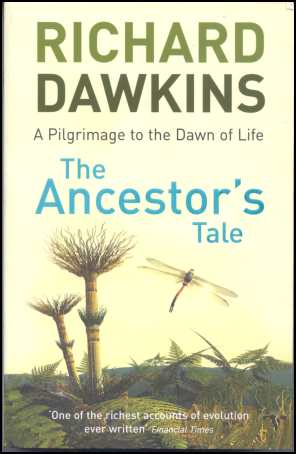
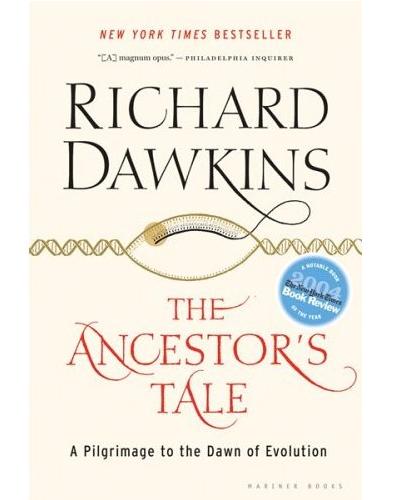
Speaking of versions, the one I read has the cover shown at the top of this post. It is a thick paperback that benefits from having four sections of full-colour plates, for a total of 50 photographs. This is the British/Canadian paperback version. The Ancestor's Tale was originally published in a very hefty hardcover version (Below Left) that many have criticised as an unsuccessful coffee-table book. The American version, both hardcover and paperback, (Below Right), subtitled A Pilgrimage to the Dawn of Evolution, is inferior to the British version since it lacks the colour photos. All in all, I think my version is the best ;-)


Dawkins occassionaly leaves science to the side to wage a campaign against the current Bush administration in Washington. I agree with his rants in this case, but worry that when Bush is no longer in power (Hallelujah!) the book will seem dated.
He also plugs his other books repeatedly, especially The Selfish Gene, The Extended Phenotype, The Blind Watchmaker, and Climbing Mount Improbable. At times, his views can seem overly reductionist (genes as the only unit of selection, etc.) but I found that he was quite well balanced in this book, preferring to let his previous works speak for him on this matter.
Dawkins brings up much-maligned German biologist Ernst Haeckel on several occasions in this book, all in a positive light, mostly about his beautiful biological drawings and his insight into the relationship between hippos and elephants. I suspect that Dawkins is intentionally doing this to irritate proponents of the ID/Creationism camp that love to use Haeckel's embryo drawings as an argument against evolution. ("Hey! you stupid creationists! Not only are Haeckel's embryo drawings still relevant, but we LOVE Ernsty!")
And speaking of Creationists, Dawkins does get in a few jabs here and there. Given his militant atheist view, it was astounding that he kept the anti-theism in this book to a minimum, anly allowing it to rear its head at the books conclusion:
'Pilgrimage' implies piety and reverence. I have not had occasion here to mention my impatience with traditional piety, and my disdain for reverence where the object is anything supernatural.... My objection to supernatural beliefs is precisely that they miserably fail to do justice to the sublime grandeur of the real world.In the final verdict, I have to say this is the best overall book for explaining evolution to non-biologists. It's not perfect, but its scope and power make it more than deserving of 5 aardvarks. As Dawkins deservedly gloats:
It is not pride in my book but reverence for life itself that encourages me to say, if you want a justification for the latter, open the former anywhere, at random.If you were to read only one biology book ever, this should be it. Go out and buy it, and tell your friends.
Duration: About 4.5 weeks.
Read about it on Wikipedia.
Return to King Aardvark's Library
24 July 2006
Evolution Software
I've always been intrigued by software that models evolution. On Good Math, Bad Math, there is a link to software called Breve Creatures, and on Pharyngula, PZ discusses this software, plus the comments list another bit of software called Framsticks. I'll be checking those out in the near future myself.
20 July 2006
Bush Vetoes Stem Cell Bill
Ugh. For someone who used his veto to kill a bill that "would support the taking of innocent human life in the hope of finding medical benefits for others," Bush sure likes having people killed. The dumb thing (other than him) is that these embryos are already there and will just get dumped in the trash sooner or later anyway.
In one of his press conferences, he had a group of children and their families with him. Each of the children had been "adopted" as embryos left over from fertility treatments by parents who bore them. He used this as evidence that each embryo is a life that can be realized.
This is a poor argument. By this reasoning, everyone should be making as many babies as possible, and our medical researchers should be putting tonnes of effort into saving the roughly 50% of embryos that are spontaneously aborted naturally. And for those of you saying that it's okay to let those embryos die because it's natural, let me remind you that we try to save people from deaths from natural birth defects all the time.
An embryo is just a collection of cells. It has no brain, no thoughts, no feelings. They have human DNA, but they are not human beings. Let the research continue.