07 February 2010

Early Valentine's Hatred

I was at the mall today getting an early jump on my Valentine's Day shopping - not because I'm keen but because I have an assload of work to do this week and will likely not have time to shop again before the big day.

So I'm in the mall and I take a detour into Chapters and buy myself a discount copy of Victor J. Stenger's God: The Failed Hypothesis for $7. Sweet. Then I go across the hall to the Carlton Cards and start looking for the obligatory Valentine's Card and I remember my card requirements (expressed to me through forcefully implied statements by my dutiful wife) - no cheap cards, no funny cards (because our relationship is important and serious and if I joke about it I devalue our relationship ... or something like that), and it must be something with good, flowery words in it expressing a loving message, but not too thorough a message because I need to write at least a paragraph expressing something loving and flowery but personal as well. So I look for a bit and find a good one and look at the price: $7.

I think to myself, WTF? On one hand, I just bought a book, a culmination of years-worth of thought and effort put into it by author and editors, almost 300 pages of quality paper and a hard binding, with dust-cover art and everything. On the other hand, a reasonably-sized sheet of cardboard, some tissue paper, and 16 lines of lame-ass poetry. Same price.

At that moment I experienced an epiphany: "Why not just substitute the Valentine's card with God: The Failed Hypothesis?" What a great idea! I could just scribble a paragraph of lubby-dubby stuff on the first page and draw a big heart and presto! Instant card. They've both got paper and writing and cost $7. Why not?

Then I realized that I don't like having my head torn off and my gonads stomped on by an angry asian woman, so I bought the damn card.

Labels: ,

10 March 2008

Ape Book

As I mentioned here, the next time I was in Toronto I planned on picking up the ape book. Well, I did. And there was much rejoicing!

(FYI: the book turned out to be a lot more scholarly than I remembered. Turns out it's by famed primatologist Birutė Galdikas, so that's some Canadian content, too.)

Labels:

27 February 2008

Monkeys fling poo, just like us!

There’s this bargain bookstore that I go to frequently in Toronto where I’ve found such wonderful things as Carl Zimmer’s Parasite Rex and Evolution: The Triumph of an Idea, which you just can’t find anywhere else these days (on sale, that is). The past couple of times I’ve been in this bookstore, I’ve covetously passed by a largish coffee table book on apes, very tempted to buy it, but each time passing it up because of the $25 price tag and the fact that it is light on fact, heavy on photos. I like info, so that's a bit of a problem. That said, many of the photos are hilarious and just prove that you don’t need to put a chimp in a tuxedo to make it funny.

However, I’m thinking that I should be picking it up, and not just to laugh at the ape antics. Part of the reason religious fundies don’t like evolution is the “I don’t come from no monkey” mindset (complete with bad grammar). They, and sadly this “they” includes my wife, think it’s a horrible, demeaning idea that we’re related to grimy, stupid, poo-flinging animals. Perhaps if they just stretched their brains more they’d see how similar we actually are to our ape cousins: that they’re highly social, that they’re intelligent problem-solvers, and that they have well-developed personalities. There is nothing wrong with being related to an orangutan1.

On the other hand, most of these people probably have already seen nature shows on tv and just filter the ape stuff through God coloured glasses. In which case my whole argument here is just rationalizing the fact that, if it’s still on the shelf, I’m buying that ape book the next time I’m there.

1 FYI, I have an uncle who strongly resembles an orangutan. He was actually conceived in Borneo, where orangutans live. We don’t want to think about what this potentially means for cross-species fertility.

Labels: , , , ,

25 February 2008

Book meme going around

I've seen this book meme going around, so I decided to preempt it after reading CL's post about it (and the handy dandy bible quote she managed to get out of it: It really is "the good book." Who cares about the meaning of life or morality? The real important stuff is how to make the carrying harness for an ark.)

Anyway, here are the rules. Yet again, screw #5. I don't know that many people.

1. Pick up the nearest book of 123 pages or more. No cheating!
2. Find page 123
3. Find the first 5 sentences
4. Post the next 3 sentences
5. Tag 5 people

I'm kind of cheating; the nearest book to me is my Handbook of Steel Construction, which would not work very well. The steel book does not have a page 123 per se. Its format is 1-12, 3-121, etc, which is very good for a design manual but not very good for memes. Most pages don't have sentences either, but instead have of tables, figures, and clauses.

So I choose the second nearest book, which is Early Greece, 2nd Ed., by Oswyn Murray. Turns out this is a university text and it's extremely dry and detailed, yet amazingly contains little actual useful detail. Here's my three sentence excerpt:
For the homeland, prosperity again, and not only among the colonizing cities: Aegina never colonized, but the basis of her wealth was the resulting trade. The religion behind the colonists also benefited: the Delphi of Apollo the Leader became the richest and most important international sanctuary, and repository of the tithes of booty from victories colonial and home. Politically the influence was most perhaps from colony to mother city.
Ugh, I should have shuffled my books around a bit before doing this. That was horrible.

Labels: ,

05 February 2008

My Wife Doesn't Agree with the Evolution of Homer

Seen here at Pharyngula is the awesome Simpsons couch gag of the evolution of Homer from single-celled life through to a homosapien (barely) on the couch. Last night's episode featured this beginning. My wife saw, and promptly exhibited her annoying fundie leanings: "Is that supposed to be evolution? I don't believe that you can get something from nothing."

I explained that evolution has little to do with how life got started in the first place; however, we still had an impasse over the whole "evolution of humans" thing. I tried to explain how the Simpons episode represents evolution in a not-too-correct way, but all this stuff takes a while to explain. It was 11:00 at night and I was tired (and apparently not a very good teacher that night because I had also failed to successfully explain how groundwater works), so I told her I could get her a book that explains evolution infinitely better than I ever could, then retrieved for her The Ancestor's Tale by Richard Dawkins from my bookcase.

She balked at its size.

Then amazingly expressed a willingness to read it (or at least excerpts - she's really not keen on reading something that big). On the condition that I read something as well. You guessed it: the Bible.

So I may be reading the Bible soon. No biggie. Even if it's a load of hooey it still has had a profound on western culture, so I stand to learn something from reading it. On the other hand, I don't know if The Ancestor's Tale is really the best book for my wife, despite my wife's utter lack of biology knowledge (she's an electrical engineer - good at physics and not much else). It's a great book, but if we're really exchanging viewpoints, a more appropriate book may be Carl Sagan's The Demon-Haunted World. It's also a lot shorter. Any suggestions?

Labels: , , , , ,

06 December 2007

Too Many Bibles

Wow, I haven't posted in a long, long time. I better get off my ass here.

Fortunately (or unfortunately), my wife dragged me to a Christian bookstore the other day, so I have something to talk about. My wife has a new Christian friend whose birthday is coming up. My wife wants to get her a bible with study guide as a gift; therefore, I had to go too.

I would like to give some observations on the bible-shopping experience:

1) There is a multitude of bibles you can buy.

For instance:

Bibles in so many translations I couldn't count them all, some of which I had never heard of before (see menu on left)
Bibles for new christians
Bibles with prayer guidance
Bibles with study guides
Bibles with archaeology guides
Bibles done textbook-style
Bibles with self-help notes
Bibles divided into 15 minute chunks read daily called One Year Bibles
Bibles presented chronologically
Bibles for people recovering from addiction
Bibles for athletes
Bibles for couples
Bibles for women (many different ones of these)
Bibles for "women of colour" (wtf?)
Bibles for men
Bibles for children - heavily illustrated
Bibles for teen girls
Bibles for teen boys

I actually have something to say about that last set of bibles aimed at teens, though it's really not just for bibles, but for all books written by uninspired adults aimed at teenagers. When you try to get teens interested in the book by using bright, fancy colours, funky fonts, hep language daddy-o!, lightning bolts, cars, and pop culture references, you come across as being incredibly lame. Highschool guidance counsellor lame. Marge Simpson lame.

Not that it isn't effective: First, other lame adults will think it's a great idea and buy it for their teenagers (who will in turn think it's lame, but the book's already been bought). Second, while teens think it's lame, preteens may very well think it's actually something cool that real teens like.

(Holy crap, I just found a bible aimed at teens that is illustrated by manga artists.)

One more thing: in the clearance annex, I was very impressed to find a tattered old bible in (what I presume) was Cyrillic. I couldn't read a damn word of it other than the publisher's email address (it's from Russia). They had bibles in a few other languages as well.

2) They are damned expensive.

Most cheaper bibles were ~$25, but the bigger, nicer, or special edition ones (with study guides, historical info, etc) were at least $35, and many were over $60. The really expensive ones were over $100.

I guess if you're the type of person who only owns one book, then it makes sense to spend a lot of money on it.

3) They are often expensive for a reason.

Christians appear to enjoy making their bibles really fancy if they can. Lots of leather/fake leather covers, fancy hard covers, fancy trim, full colour pages. Gone are the days when most bibles were small things with whispy-thin onion-skin paper like you'd steal from hotels.

Not only that, but publishers will produce several versions of the same bible but with wildly differing cover materials and colours. (I'd like a NIV Bible, with black leather, metallic red paint, nav system, 6-disc CD changer, and spoiler please.)

4) Chritstians love to buy protective carrying cases for their fancy, expensive bibles.

No joke. Many were sold in clear plastic protective cases. Some other hard plastic cases were of very high quality with a variety of fasteners, which would protect your bible in near-mint condition. You also have colourful vinyl cases, canvas cases, fake suede cases, and nylon cases, with buckles and zippers and all sorts of pewter ornaments like Jesus fish and crosses. Moving higher upscale, you can get really fancy leather carrying cases with metal crosses and logos and freakin' combination locks (my wife has one). It's crazy.

That said, I'll bet Carlo is interested in getting one of these carrying cases (if he doesn't have one already).

Labels: ,

28 September 2007

Year of Living Biblically

An author by the name of A.J. Jacobs has just come out with a new book, called "The Year of Living Biblically." As the name suggests, this guy went for a whole year trying to follow the bible as closely as possible. I found out about him on a post at The Friendly Atheist and was intrigued. I'm probably not going to buy the book, mainly because I'm cheap, but if you find an interview, read it. It's fun. The Friendly Atheist link above has a link to a Newsweek interview that's pretty good.

Last night while my wife was at the dentist, I was searching for a magazine to read. Lo, as I was about to toss it aside as the crap it usually is, I noticed that a Macleans near the top of the pile of magazines mentioned it had an article on the book inside.

Twas an interesting, though quick read (I guess he wants us to buy the book). The author claims to be agnostic, and remained so by the end of the ordeal. He took pride in arguing with religious people, not in a condecending way: he would talk their ears off with lots of questions and observations, eventually getting a Jehovah's Witness guy to get sick of him and leave (after 3 hours). So this is an interesting guy.

So what did he have to do based on a literal interpretation? For starters, there's the dollop of olive oil he put on his head every day. Also, the big, untrimmed beard. All white clothing of unmixed, natural fibres (he even brought in a fabric expert to come check over his wardrobe to point out the "illegal" articles of clothing). He even chucked little tiny rocks at a guy he met who admitted to being an adulterer. Apparently, he was kind of morbidly eager to try out the whole stoning thing but felt bad about hurting people, so he carried around little rocks to stone people with because "the bible doesn't say what size of stones to use."

The most difficult requirements are actually the simple ones - no coveting, gossiping, or lying. Basically thought-police stuff. The other difficult stuff had to do with things that got in the way of his family life. For instance, you can't sit in a seat where a menstruating woman has sat. Because she was getting annoyed with the whole project, his wife intentionally dragged her butt across every piece of furniture in their apartment while she had her period.

That, and the whole sexism thing were problems. As recounted in the Newsweek interview, "Parts of the Bible say that the man is the head of the household and should make the decisions, which did not translate into reality in our household."

Tell me about it.

Labels: , ,

11 June 2007

Behe's Book in Chapters

I was at a Chapters store over the weekend, and to my dismay, they were heavily promoting Michael Behe's new book The Edge of Evolution. (PZ's been dismantling the book over at Pharyngula) There were dozens of copies on display not only in the New Releases section right when you enter the store, but also in the science section as well (spits). The good news is that absolutly no one was looking at them (except me, of course). The bad news is that no one was looking at any of the atheist books that were also being promoted, such as Christopher Hitchens's God Is Not Great, and only one other person was in the science section of the store at all. And he wasn't even really looking for books - he was scouting to find any youngish people in the section so he could ask them a) if they had a science educational background, b) if so, which university would they recommend for his cousin's son, and c) are they interesting in doing some part time technical work for his company.

I chatted a while, answered his questions ( a) yes, engineering and also did a little biology, b) listed some of the bigger name universities that I trusted, and c) no. ), then left without buying anything. I can't afford to spend $20-30 on a book right now and the discount science section is a single poorly-stocked shelf. One freakin' shelf. The religion and woo discount sections have a large bookshelf each, each with 4 or 5 shelves. That speaks volumes about the scientific literacy of our society.

One thing I did notice was that a large portion of the science books actually dealt with religion. Of course there's the Dawkins et al. stuff, but there were also many books about the biological basis for belief, many books from apologists trying to use science to prove God, and some books that really didn't talk about religion at all but just used God in the title to try to sell more copies. The intersection of science and religion really is a hot topic right now.

Labels: , ,

06 May 2007

Richard Dawkins on The Hour

Richard Dawkins will by on CBC's The Hour with George Stroumboulopoulos on Monday to discuss The God Delusion. I'm not sure if I'll be able to watch tomorrow, but it should be cool. I don't watch The Hour that much (just a little if nothing else is on, plus I watched the one where The Hip came on to promote World Container) but George is a much better TV host than Bill O'Reilly.

Speaking of TV, I was just watching video game review show X-Play on the tube this morning (this is what I do when I'm at home alone waiting for hockey). They were reviewing the little-known game Darwinia. Darwinia is based on the premise of a virtual evolving AI world that you need to save, kind of a strategy game. Being that it mentions evolution, the host took a great deal of time bashing Kirk Cameron and has wacky creation science views. Nice to see that loser nerd boys are anti-creationist.

Labels: , , ,

27 April 2007

Excerpts of God is not Great

Via BigHeathenMike and OneGoodMove, here are excerpts of Chris Hitchens's new book God is not Great in Slate. I heard about this book before but never actually learned about what's in it. From a review on Amazon,
In the genre of athiest criticism of religion, Hitchens' book fills a niche. Where, for example, Bertrand Russel approaches religion with a philosophical mind, and Richard Dawkins approaches religion with a scientific mind, Hitchens approaches religion with a literary mind....And in this sense Hitchens has hit upon an angle to come at religion that is not usually trodden: popular religion, unlike great literature, resists the tragic, the ambiguous, and the particular. Thus if you love literature, and identify with frail humanity via literature, you will resist the easy platitudes of religion.
I'm not really one of a literary mind (I only grudgingly took the madatory English credits in high school), so getting the Dawkins book is higher on my priorities list, but it looks interesting.

One other thing, the subtitle of this book is How Religion Poisons Everything. Some have pointed out that this is unnecessarily sweeping, much like Dawkins's documentary The Root of All Evil. Maybe. It sure poisons many things. One thing is for certain: the cover of this book is poisoned. Seriously, gaudy orange background and tacky fonts? What were they thinking?

Labels: , , ,

27 March 2007

Jared Diamond's lack of respect for priests

I've just started reading Jared Diamond's Guns, Germs, and Steel, which is so far an outstanding book. Just a quick note: early on, Diamond is discussing the beginnings of food production and its repurcussions, including the establishment of chiefs, bureaucracy, scribes, artisans, and priests. The last one, priests, he does not justify as being to tend to the spiritual needs of the early villagers, rather, as he term it, "Stored food can also feed priests, who provide religious justification for wars of conquest...." Get that? Religion is just there so that the masses will support the greed of the powerful.

Labels: , ,

12 February 2007

Darwin "Go ahead, make my" Day

Today, February 12, 2007, is the 198th birthday of one Mr. Charles Darwin - Darwin Day. You may know him as a pioneering biologist, father of our current understanding of evolution and much beat upon whipping boy of religious nutjobs. All in all, he's handled all the abuse rather well, so today is a day we celebrate the great man.

But did you know that Darwin was a cold, calculating mass murderer?

Well, not exactly, but one thing that amazed me was, for someone so interested in studying wildlife, he certainly blew away a lot of it. Darwin was an avid hunter, spending the last few days in England before the Beagle voyage hunting partridges with his uncle. His first specimen recovered on the Beagle came when the ship was waiting in quarantine off the coast of the island of Tenerife, where he took his pistols on deck and blew away a black-backed gull to get at its stomach contents, eventually preserving a cuttlefish from the endeavor. During the Beagle's voyage, he enjoyed hunting a variety of new and exotic species, often revelling in discovering how each tasted (apparently, the dome-backed Galapagos tortoises tasted better than the saddle-backed ones). Oftentimes this was for survival - the ship needed meat for the crew - however, the impression was definitely gained that, while appreciating the beauty of life, he also appreciated being able to just up and whack it as well.

Darwin hunted rheas in Patagonia; slaughtered countless boobies and noddies on St. Paul's Rock; shot a large lizard in Bahia; shot bearded monkeys, a crotophaga, and some parrots and toucans in Rio; a condor near Port St. Julian; capybara in Montevideo; and various birds on the Galapagos, just to name a few.

Darwin was an interesting fellow. In addition to filling all manner of beasties full of lead, as a youth he also spent much time examining and collecting wildlife of all sorts. At 16, he took a microscope off with him to medical school - not for classes or labs, but for fun. During university he collected beetles. At 17, he was playing with cuttlefish. He would grab and torture sea mice just to see how they reacted. At 18, he was seriously studying zoophytes.

In fact, his somewhat sadistic bent resulted in this essay from the Institute for Creation Research (as loathe as I am to link to them). It is kinda funny. (They quickly go from the defensible position that Darwin was a little too gun-happy, even for his era, to the weird position that his eagerness to hunt things directly resulted in his theory of natural selection.)

I've been reading two books recently about Charles Darwin's life and adventures on the way to coming up with the theory of evolution through natural selection. The first is Fossils, Finches, and Feugians by Richard Darwin Keynes, about Darwin's time on the Beagle, and the second is Darwin and the Barnacle, about his zoological pursuits that helped come up with the common descent part, specifically the 8 or so years in which he became the world leader in barnacle research.

Dubious enjoyment of killing aside - society has changed such that gratuitous animal killings are no longer acceptable - these books give a sense of what's missing in our education and childhoods today. We're missing that hands on element - science is taught purely out of textbooks these days. How many of us as kids were encouraged to run around and torture little animals to see for ourselves how they worked? Darwin did a lot of it. Some kids still do it today but it's getting more rare; my niece will chase after little snakes, and it's a wonder to behold, but it's not too common. Inquisitiveness like that, like what Darwin showed, is the greatest gift a person can have.

Links: Darwin's account of the Voyage of the Beagle.

Labels: , , ,

22 November 2006

Getting Medieval

I haven't been following the whole religion/atheism thing or even much science in recent weeks/months. For the past little while, I've been indulging in one of my other nerdly loves: medieval history.

In the past little while, I've read Terry Jones' Medieval Lives (debunking the myths surrounding our view of the Middle Ages), Norman Cantor's The Last Knight (looks at late Medieval society using John of Gaunt as a reference), and I'm just finishing Brian Clegg's The First Scientist (about pioneering friar Roger Bacon). On the side, I'm reading the large and very general Ancient History by J.M. Roberts. I also got a book on Medieval military techniques for my birthday, and I know that I'm getting a book on the Normans for Christmas.

It's been nice to get away from the constant onslaught of religiosity that I get when I go to church with my wife or even talk to her at home. I get enough of the religion-bashing content from Pharyngula. Even reading Carnival of the Godless has become a chore of late, so a little history is a good diversion.

But even then I cannot escape. The Ancient History book contains chapters on whatever religions make a historical impact. Both Terry Jones' book and Norman Cantor's book contain some reference to the church and religion. It makes sense: religion was a huge factor in the lives of Europeans. One could say that without Christianity there would be no Europe. But in these books it was a small part.

Not so for The First Scientist. Like CotG, this book has been a chore. That's what happens when the subject is a friar and works for the pope. It's been an interesting, though frustrating, read; it really makes you wonder how much the church held back intellectual development.

For those who don't know (and I'm sure most don't), Roger Bacon (no relation to Francis Bacon) was an Oxford-trained scholar back in the 1200's. He was deeply interested in the natural world and was arguably the first to combine purely theoretical natural philosophy (a la Aristotle) with the demand for experimental proof - hence the title "the first scientist." Among his topics of study were optics, cartography, astronomy, alchemy, and languages. However, early in his work, political turmoil resulted in the loss of his funding as his family lost their wealth. Always a deeply religious man, he joined the friary as a way to continue his studies, and even arranged a deal to produce a scientific treatise for the pope. Unfortunately for him, the pope he was working for died and the one who replaced him instilled a culture that allowed no dissent from accepted theology; no challenging authority was tolerated. Bacon, always a disturber, was locked away for over 10 years, though this was probably over his religious rather than scientific views. He was eventually released but did not accomplish much else before his death.

His life story just makes me angry.

In a more free intellectual time, Bacon himself might have sparked a scientific revolution 400 years earlier than what actually occured. He was not a very good scientist, and, although he advocated empiricism, he himself was a poor experimenter; nevertheless, his works show a new way of thinking and a new way of skepticism that could have led the way to real scientific discovery had the culture of the time not been rooted in mysticism and religion.

As for Bacon, that mystical and religious culture perverted his memory into that of a magician and alchemist. It was not until the dawning of the scientific revolution that some scholars looked back on Bacon's works and said, "Hey! This guy was on the right track 400 years ago."

Labels: , , , ,

04 October 2006

Me and My Brother are Nerds

Today I received a cry for help from my brother - a simple, one line email:

"I'm out of books."

I replied: "That's a cry for help. I'll bring you Ancestor's Tale this weekend. That should keep you golden for about a month. I might bring you two books, just to be safe, because after that I'm not coming home again until birthday. Then you get another 2 books."

Yes, we are both nerds. And my dad's a nerd. When any special occasions come along, we just exchange nerd books. We have an extensive library of nerd books.

Speaking of that, I'm pissed off. I bought The Ancestor's Tale paperback (the nice british version) at Chapters at full price, ~$23 CDN a few months ago. I went back there last weekend and found a whole slew of the softcover version of the hardcover (full glossy pages, lots of extra colour illustrations) in the bargain area for $10! Ten freakin dollars! Pissing me off. Anyway, I bought a copy just for the pictures, and I'm going to give that to my brother when I go home for Canadian Thanksgiving this weekend. Of course, after he's done reading it, I'm taking it back. If he wants his own copy, I'll give him the paperback version.

Labels: ,

04 August 2006

Dawkins Would Be Pissed ... or Not

I just took a detailed visited the local public library for the first time.

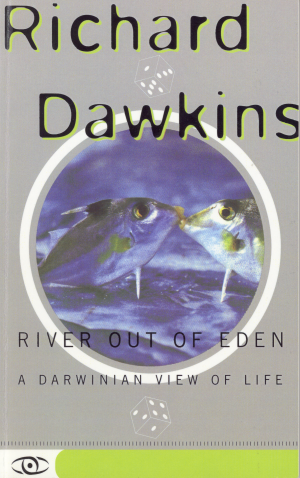
Richard Dawkins would be pissed: Right next to his book River out of Eden is Darwin's Black Box, by Michael Behe.

Behe: Well, well, what do we have here?
Dawkins: A little too close for comfort, eh loser boy?
Behe: Bring it on, chump!
Dawkins: I'm gonna kick you in the nuts!
Behe: Owww! (slumps to the ground)

Or maybe not. Dawkins might be happy that his book is there next to Behe's. I doubt a person perusing the biology section for fun would be persuaded by Behe's arguments, though they might find themselves with a wasted weekend after discovering that the interesting, controversial book they picked up was complete rubbish. Meanwhile, an evangelist sympathizer who normally reads faith-based books would have to go to the biology section and see how greatly outnumbered Behe's book was compared to the real evolution books.

In fact, with the word Eden in the title, it might entice a religious reader to pick up both books, figuring they are complementary (they are next to each other, after all). Who better to counter fundamentalist arguments than Dawkins? Though, content-wise, The Blind Watchmaker or Climbing Mount Improbable would be far better than River out of Eden as Behe's neighbour; either more directly delivers kicks in the nuts to the irreducible complexity argument.

Anyway, I'll be going back there soon. They have the Carl Zimmer book Parasite Rex that I want to read (but alas, no At the Water's Edge). For a book that interesting, I'd prefer to buy it, but I haven't been able to find it around, and I don't like buying things online. They also have plenty of the older Stephen Jay Gould books that I'd like to see.

Labels: ,

03 August 2006

The Ancestor's Tale - Book Review

The Ancestor's Tale: A Pilgrimage to the Dawn of Life
- Richard Dawkins (2004)

Rating:
(5/5 Aardvarks)


Ratings explained at
King Aardvark's Library


"If you were to read only one biology book ever, this should be it." - King Aardvark


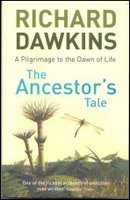
The Ancestor's Tale: A Pilgrimage to the Dawn of Life (2004) by Richard Dawkins is a remarkable book. The book's premise is, starting with humans, to go back in time to rendezvous with the most recent common ancestor, which Dawkins terms a "concestor" (boy, this guy sure likes making up words), of us and another group of still living organisms. (For instance, in the distant past, one of these meetings is between all the mammals, including us humans, and the group of birds and lizards. We never meet dinosaurs; they are extinct, so they don't count, but they are represented by their surviving family members, the birds.) The book is designed to emulate the format of Geoffrey Chaucer's The Canterbury Tales, where pilgrims meet on the way to their destination and tell tales.

The overarching story is that of time-traveling discovery: who, rather than what, is around the next corner? Dawkins traces the evolutionary branchings of life, taken from a well-justified anthropocentric position (as humans, we're tracing our own geneology), giving approximate dates where possible and explaining the importance of each set of organisms.

Frequently, when each set of organisms join, a joining species will tell a tale. Each tale is a stand-alone essay that uses something relevant to the particular species to explain something truly important about evolutionary biology. Sometimes it's about a speciation mechanism, like sympatric or allopatric speciation; sometime it's about organisms rafting to islands and miniaturizing; sometimes it's about techniques used by evolutionary biologists, like molecular clocks, dendrochronology, etc; sometimes it's about convergent evolution, or hypotheses into the development of the brain, or Dawkins's own favourite topic, selfish genes. These tales provide a feast of biological tidbits and are the true masterpieces of this book.

This is truly a magnificent book. I felt like I was actually traveling backward through time, and sharing in the monumental discoveries of past biology, until, finally, a rapid-fire crescendo of sponges, plants, the Great Rendezvous of the first eukaryote, bacteria, then the cathartic climax of reaching our evolutionary Canterbury: the mysterious beginnings of life. On this, Dawkins wisely leaves it to conjecture; it could be RNA world or it could be other things we haven't even thought of yet.

It is well-written, fast paced, comes in easily-digestible morsels, and full of cutting-edge science, all easily accessable to the layman. Dawkins comes across as delightfully inquisitive and genuine. One of the most admirable things I noticed about The Ancestor's Tale is how freely Dawkins would admit that there remain things yet unknown. For instance, in many cases, he points out a disagreement between scientists about where certain animal groups branch, then explains why he chose one scheme over another, and that future data could cause our understanding of these relationships to change. He even has a couple of places where the order of meeting concestors is still up in the air. He never gives the impression that he is all-knowing or infallable, and I felt respected as a reader because of this.

I was disappointed, however, with the bias toward animals shown by Dawkins. The section on fungi is brief; plants, arguably the most important organisms, are treated only slightly better. Archaea are almost entirely avoided. The early interplay of genes between the primitive Archaea, Bacteria, and Eukarya is merely skimmed over. There is hardly any discussion about the status of viruses or prions to speak of.

One minor complaint is that the essays about the biology topics are linked to a particular organism that exhibits the topic the best. While this is logical, it also results in problems where vitally important topics are not discussed early enough. For example, the essay on dating historical artifacts, fossils, and geological formations is told during the Redwood's Tale, notably because these large old trees can help us date organisms via dendrochronology. Dating of other types are discussed, too, including paleomagnetic and radiometric dating. Understanding how these dating methods work is essential for building the trust of those skeptical of science. How many times have I heard the "you use the rocks to date the fossils, but you use the fossils to date the rocks" argument? Unfortunately, Redwoods are plants, and plants separated from animals so far in the distant past that this tale is not told until page 526 out of 629 pages (in my version).

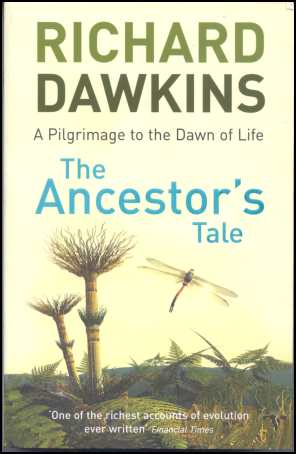
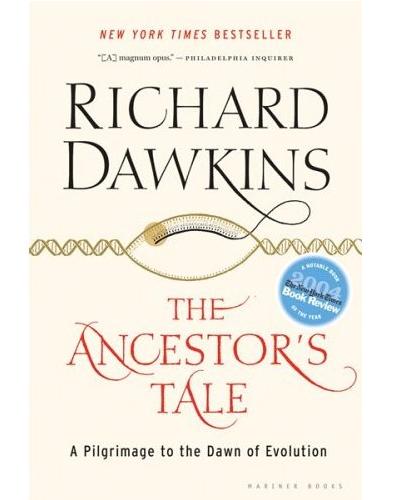
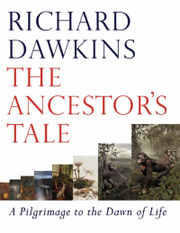
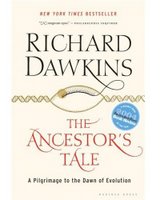
Speaking of versions, the one I read has the cover shown at the top of this post. It is a thick paperback that benefits from having four sections of full-colour plates, for a total of 50 photographs. This is the British/Canadian paperback version. The Ancestor's Tale was originally published in a very hefty hardcover version (Below Left) that many have criticised as an unsuccessful coffee-table book. The American version, both hardcover and paperback, (Below Right), subtitled A Pilgrimage to the Dawn of Evolution, is inferior to the British version since it lacks the colour photos. All in all, I think my version is the best ;-)
Dawkins occassionaly leaves science to the side to wage a campaign against the current Bush administration in Washington. I agree with his rants in this case, but worry that when Bush is no longer in power (Hallelujah!) the book will seem dated.

He also plugs his other books repeatedly, especially The Selfish Gene, The Extended Phenotype, The Blind Watchmaker, and Climbing Mount Improbable. At times, his views can seem overly reductionist (genes as the only unit of selection, etc.) but I found that he was quite well balanced in this book, preferring to let his previous works speak for him on this matter.

Dawkins brings up much-maligned German biologist Ernst Haeckel on several occasions in this book, all in a positive light, mostly about his beautiful biological drawings and his insight into the relationship between hippos and elephants. I suspect that Dawkins is intentionally doing this to irritate proponents of the ID/Creationism camp that love to use Haeckel's embryo drawings as an argument against evolution. ("Hey! you stupid creationists! Not only are Haeckel's embryo drawings still relevant, but we LOVE Ernsty!")

And speaking of Creationists, Dawkins does get in a few jabs here and there. Given his militant atheist view, it was astounding that he kept the anti-theism in this book to a minimum, anly allowing it to rear its head at the books conclusion:
'Pilgrimage' implies piety and reverence. I have not had occasion here to mention my impatience with traditional piety, and my disdain for reverence where the object is anything supernatural.... My objection to supernatural beliefs is precisely that they miserably fail to do justice to the sublime grandeur of the real world.
In the final verdict, I have to say this is the best overall book for explaining evolution to non-biologists. It's not perfect, but its scope and power make it more than deserving of 5 aardvarks. As Dawkins deservedly gloats:
It is not pride in my book but reverence for life itself that encourages me to say, if you want a justification for the latter, open the former anywhere, at random.
If you were to read only one biology book ever, this should be it. Go out and buy it, and tell your friends.

Duration: About 4.5 weeks.

Read about it on Wikipedia.

Return to King Aardvark's Library

Labels: ,

17 July 2006

King Aardvark's Library

I read too much, I thought we should kill ourselves.
She doesn't read a thing; she believed me.
"Are you really the messiah?"
"Yes, I am.... Believe it."

- Highway Girl (Double Suicide version), The Tragically Hip.

King Aardvark is an avid reader, reading much, especially non-fiction. Reading is done anywhere: at home, on the job, on the beach, on "the throne" (read: the bathroom). Much reading gets accomplished sitting on the can. Don't call it gross; it's called multi-tasking.

So in order to give something back to the peasants from the multitude of works of literature I've read, I will start posting my reviews of books that I have in my library. Detailed reviews of each book will be linked from the table below once I post them. I mostly read non-fiction, especially science (mostly biology and cosmology) and history (mostly war, science, mediaeval, ancient, and classical civilization). Sometimes I read lighter works, or fiction, or something my wife wants me to read, such as self-help relationship books. All are fair game.

I will then review each work on a scale of 0 to 5 aardvarks, a subjective rating on how I liked each book. In addition, the top books, those receiving 4 or 5 aardvarks, receive the honour, by royal decree, of being named a "Crown Jewel of King Aardvark's Library". Those receiving 0 or 1 aardvarks receive the dubious distinction of “Ant” status; a book so bad that it deserves to be eaten and turned into a very small amount of poop out my regal backside.


Books Reviewed in Royal Library
Book TitleAuthorScore
The Case for a CreatorLee Strobel1/5
The Last Three MinutesPaul Davies5/5
The Ancestor's TaleRichard Dawkins5/5
Creation: Life and How to Make ItSteve Grand4/5
After ThoughtJames Bailey1/5
Destruction of the BismarckBercuson&Herwig3/5
Europe: A HistoryNorman Davies4/5
Fly: An Experimental LifeMartin Brookes4/5
Lost Civilizations of the Stone AgeRichard Rudgley3/5
The Dragons of EdenCarl Sagan3/5
The Demon-Haunted WorldCarl Sagan4/5
Eco HomoNoel T. Boaz3/5


(Note: books that score 0 or 1 aardvark are listed as “Ants” while books with a rating of 4 or 5 aardvarks are, by royal decree, listed as Crown Jewels of King Aardvark's Library).

Labels:

Case for a Creator review coming


I read too much. In the coming little while, I intend to start doing reviews of books that I'm reading or have recently read, so that I can give back a little to other avid readers. I read mostly non-fiction (science and history mostly), but there are going to be exceptions. The first exception is going to be The Case for a Creator: A Journalist Investigates Scientific Evidence that Points Towards God (2004) by Christian apologist Lee Strobel. The so called "scientific evidence" is almost exclusively fiction. I'll also look at more sensible books, like The Ancestor's Tale by Richard Dawkins, which I'm currently reading, and The Last Three Minutes by Paul Davies.

Now, you're probably wondering why I would read a book such as The Case for a Creator when I'm an atheist. Well, I was asked to by my wife who thought it would be a good way to try to open my mind toward accepting God. Instead, it just showed me that the best Christian apologists can come up with are just empty philosophical comments and some outright fabrications.

I then wanted to see what other skeptical readers thought about the arguments, in the same vein as the Talk Origins reviews of Jonathan Wells' Icons of Evolution or Michael Behe's Darwin's Black Box. But the only one I could find was this one, by Paul Doland of Internet Infidels, so I've decided to do my own series looking at the arguments, each chapter in turn. Look for that in the future as well.

In the meantime, check out the Wikipedia article for The Case for a Creator (link above), which I wrote and organized a lot of, just to get a feel for what's involved in reviewing this book. Note that the article has to be carefully NPOV and general, so I can't tear into it the way it deserves.

Labels: , ,